In one sentence
The service is managed with ePatrol, a digital platform that records every patrol, attendance and report on the spot and makes them verifiable by the client in real time.
Ready-to-copy texts, commitments you can sign up to and screens to attach: everything you need to show the contracting authority how you will control the service.
Use the one that fits the space you have: many proposals have a page limit.
The service is managed with ePatrol, a digital platform that records every patrol, attendance and report on the spot and makes them verifiable by the client in real time.
To plan, carry out and control the service the bidder uses ePatrol, a digital platform made of a web console and an app for operators, available for iPhone and Android. Every point to be checked is identified by an NFC tag: the operator reads it with the phone and the system records the time, the position and who walked by. Patrols, shifts, attendance, reports and documents flow into a single archive, which the client can consult with its own restricted access. If a patrol is missed or a shift is left uncovered, the office is alerted within seconds and can act straight away.
The bidder manages the service with ePatrol, a subscription digital platform that requires no installation in the client's systems. The platform has two parts that work together.
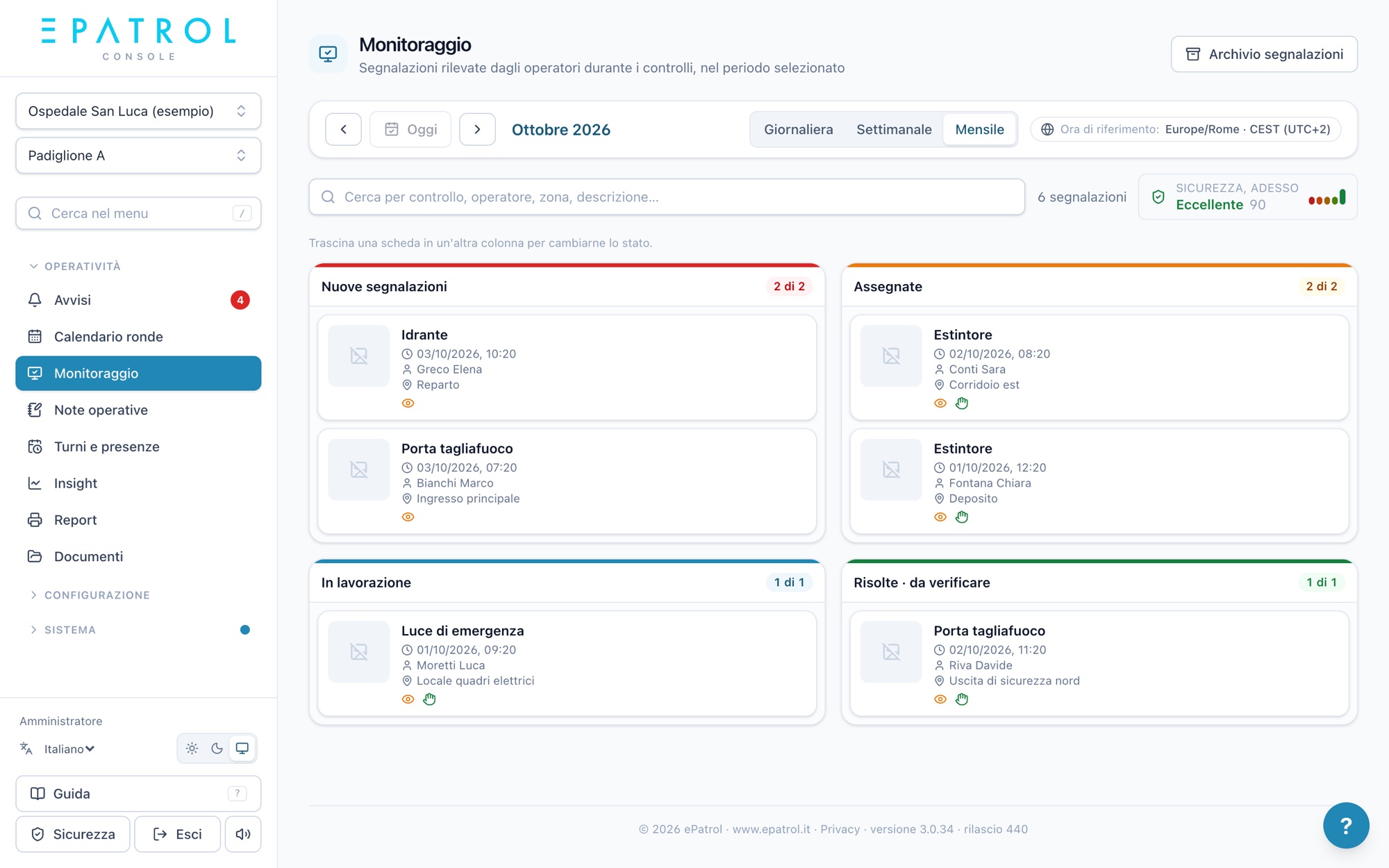
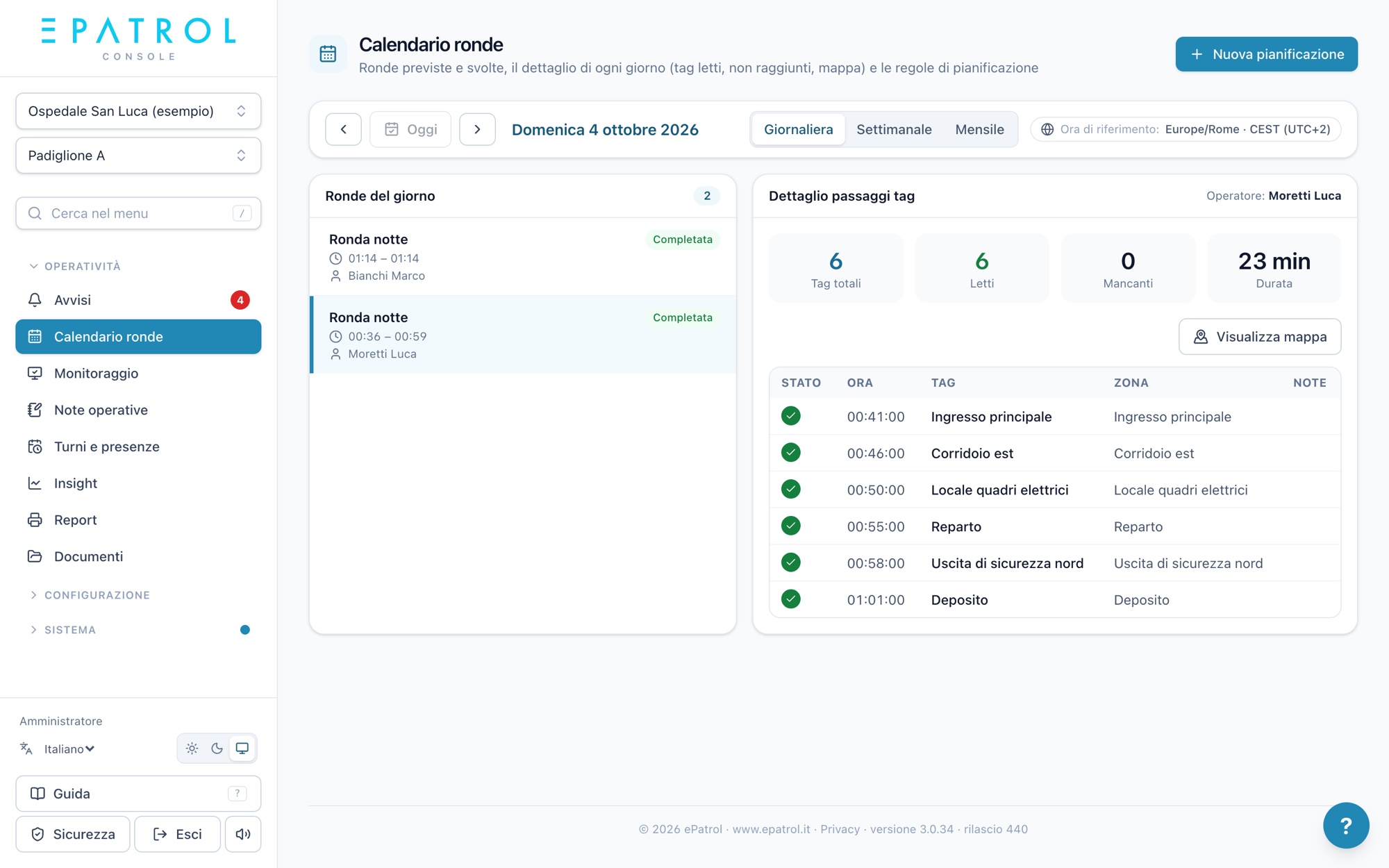
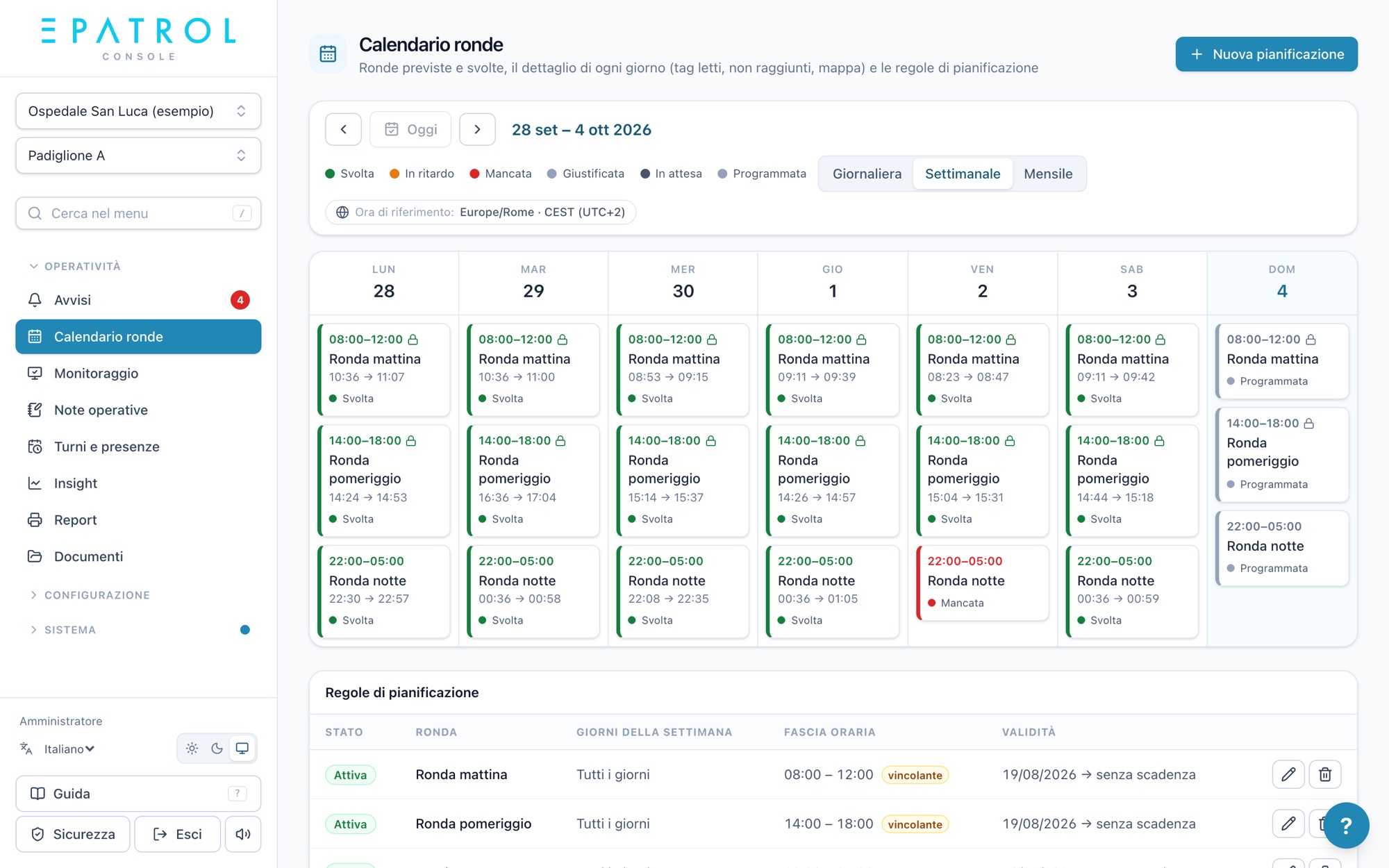
The web console is used by the bidder's control room and, with dedicated permissions, by the client, by maintenance staff and by any subcontractors. It is where patrols and shifts are planned, the service is monitored, reports are followed through to closure, documents are archived and reporting is produced.
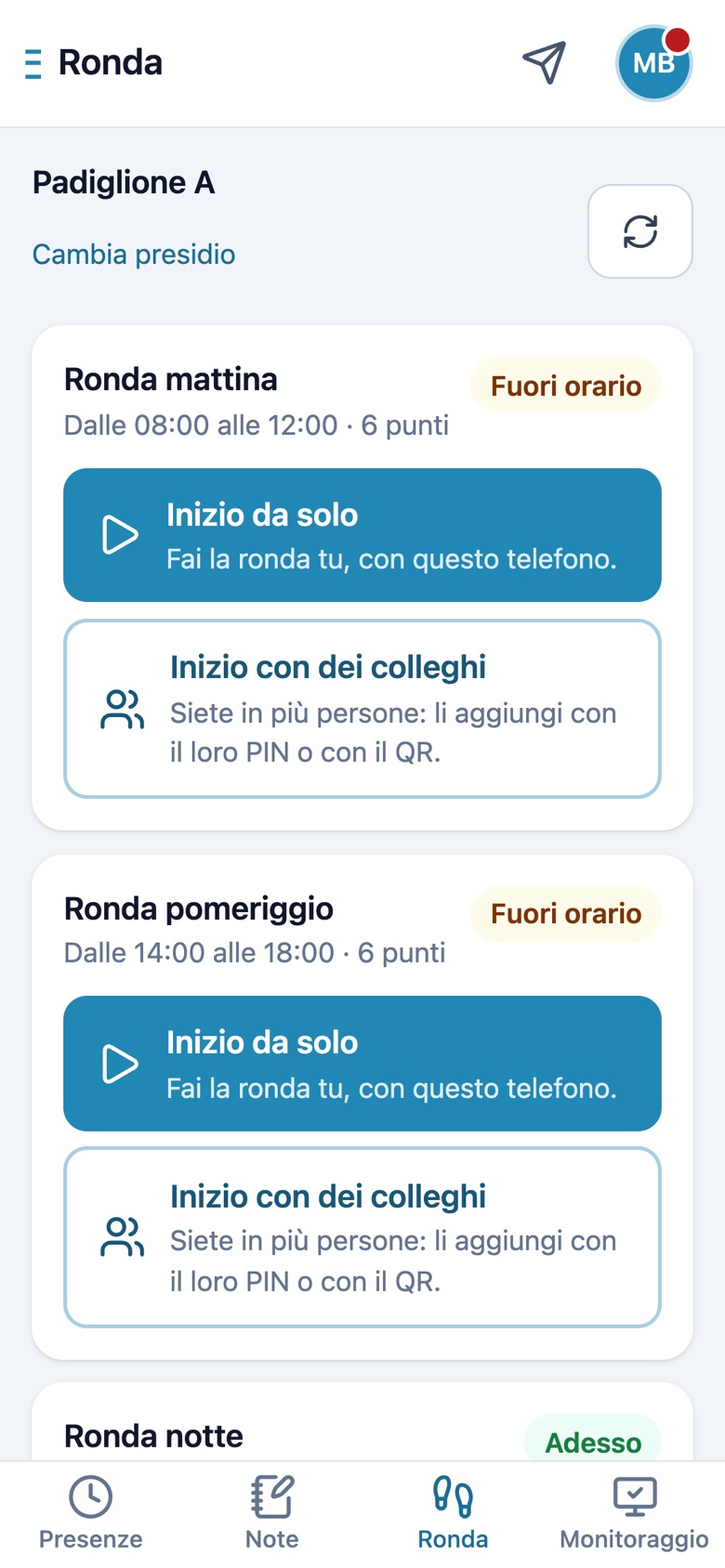
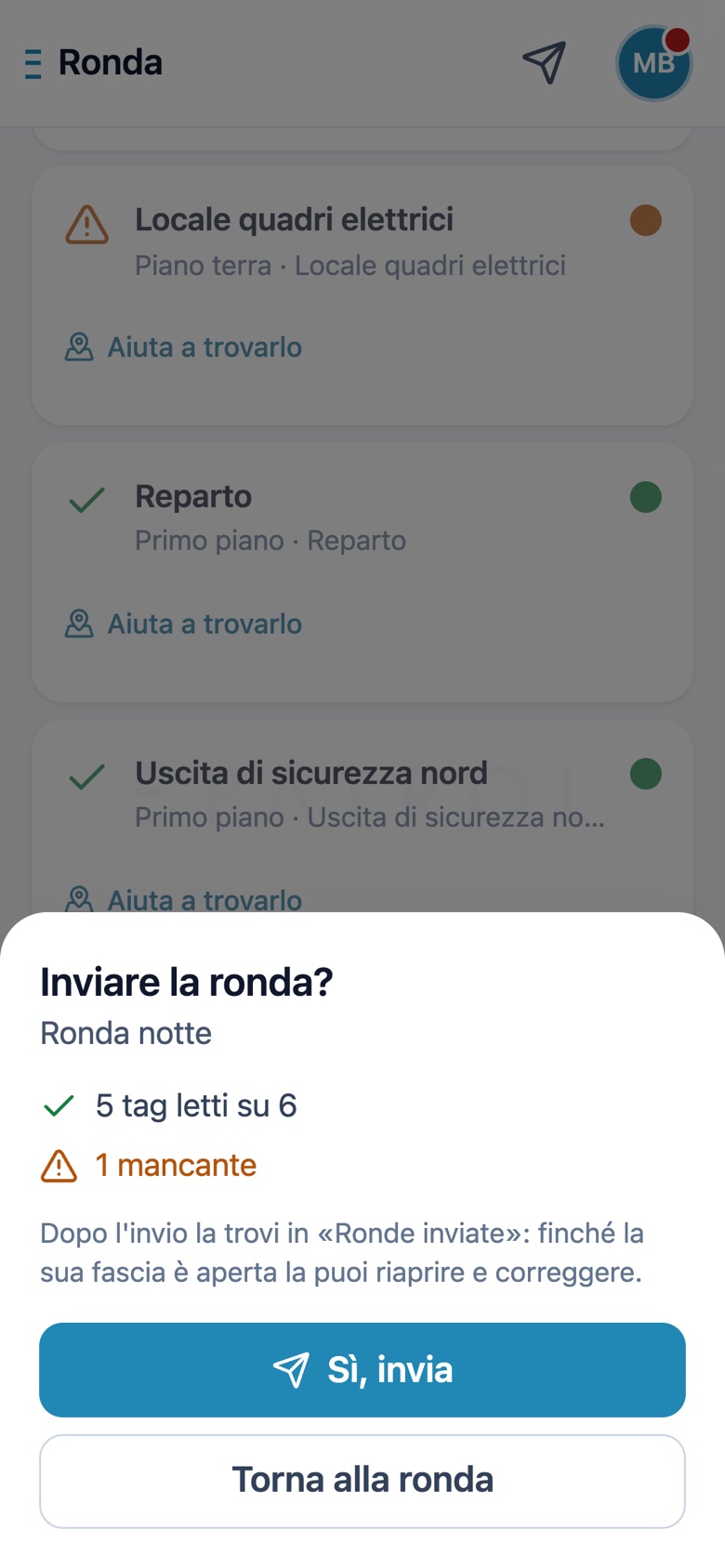
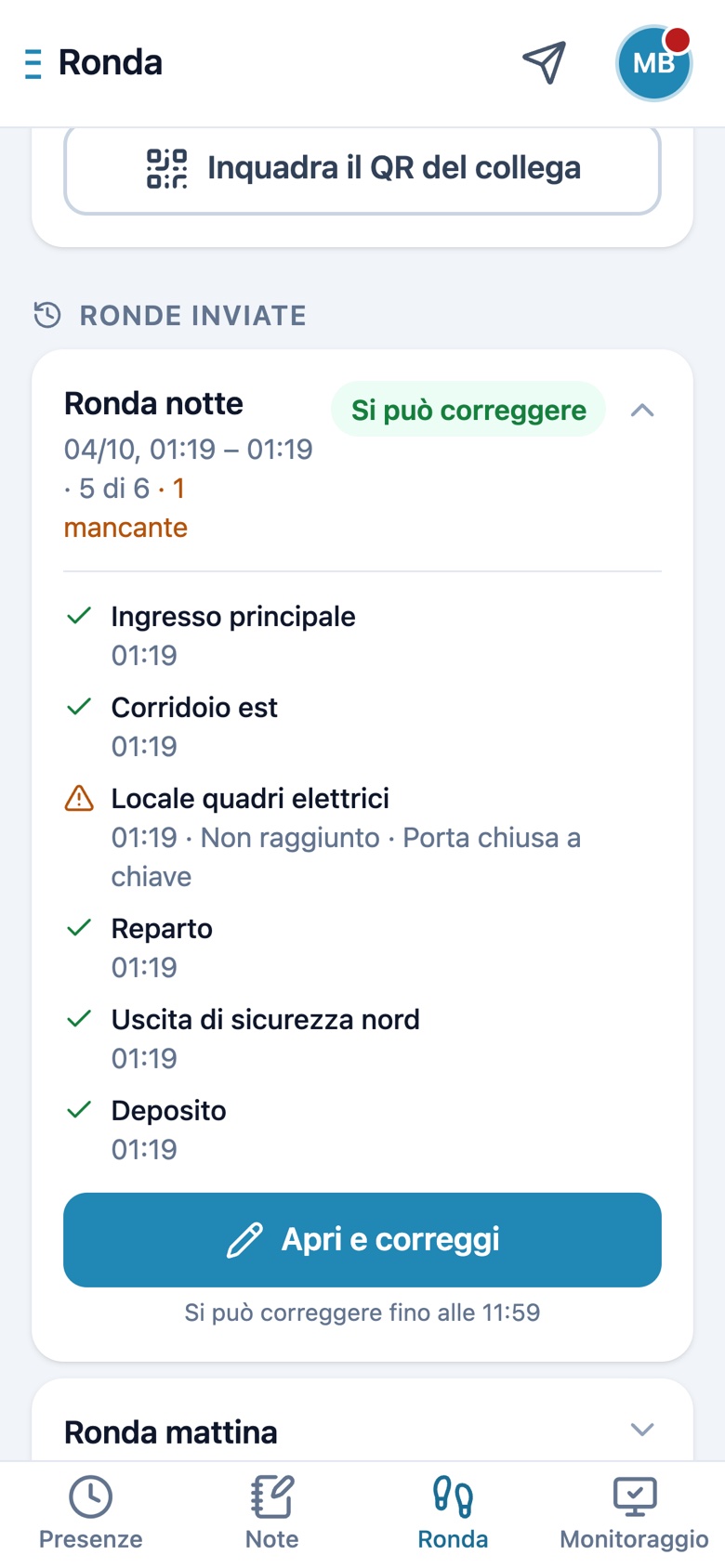
The app for operators, available for iPhone and Android in six languages, guides staff in the field: the day's patrols, reading of checkpoints, clocking in and out, reporting of faults with a photograph, the handover log between shifts. The app also works with no network: data stays on the phone and is sent automatically as soon as the signal returns.
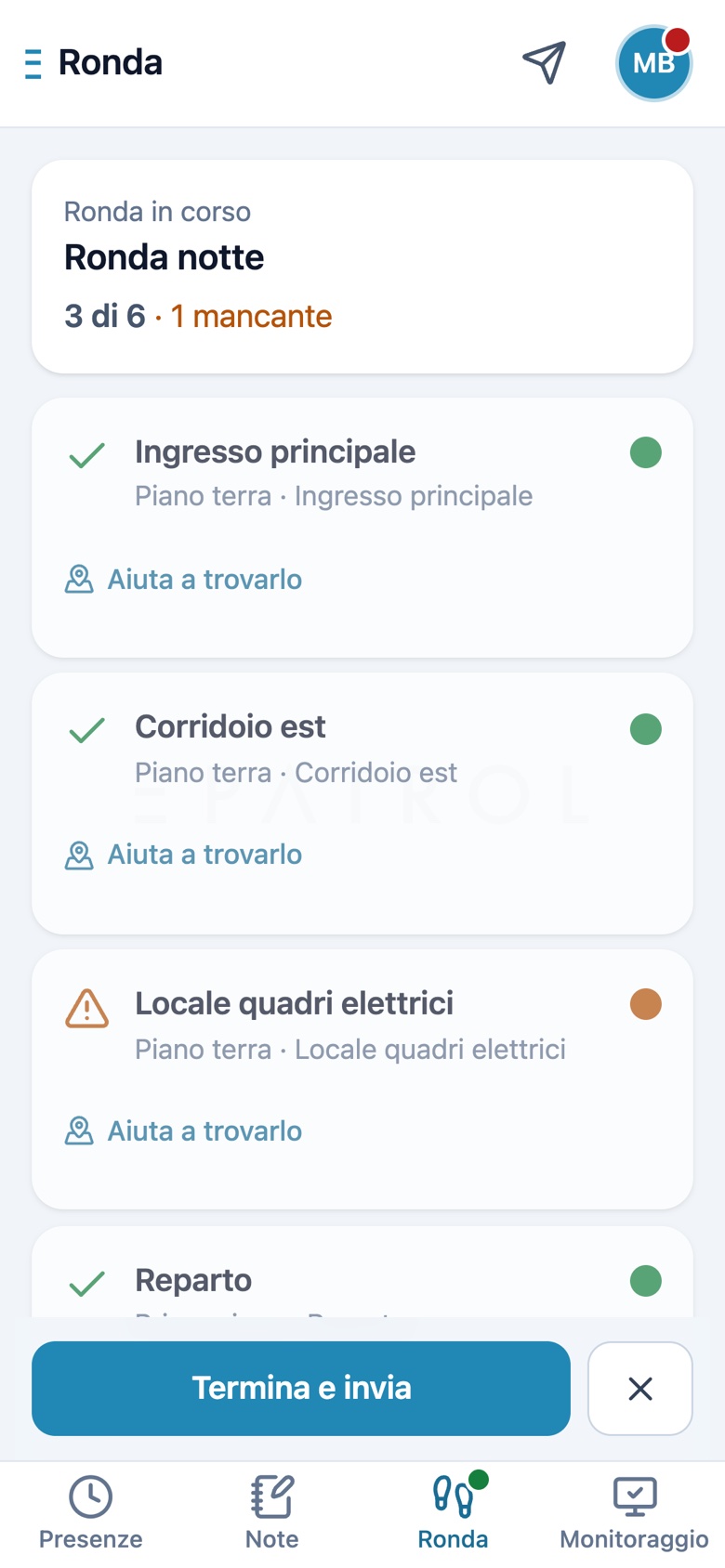
Every point to be checked is identified by an NFC tag fixed on site. Reading the tag records the time, the position and the operator: each visit is therefore documented objectively, point by point. A point that cannot be reached can be declared as such only when standing on site and stating the reason, with a photograph if needed.
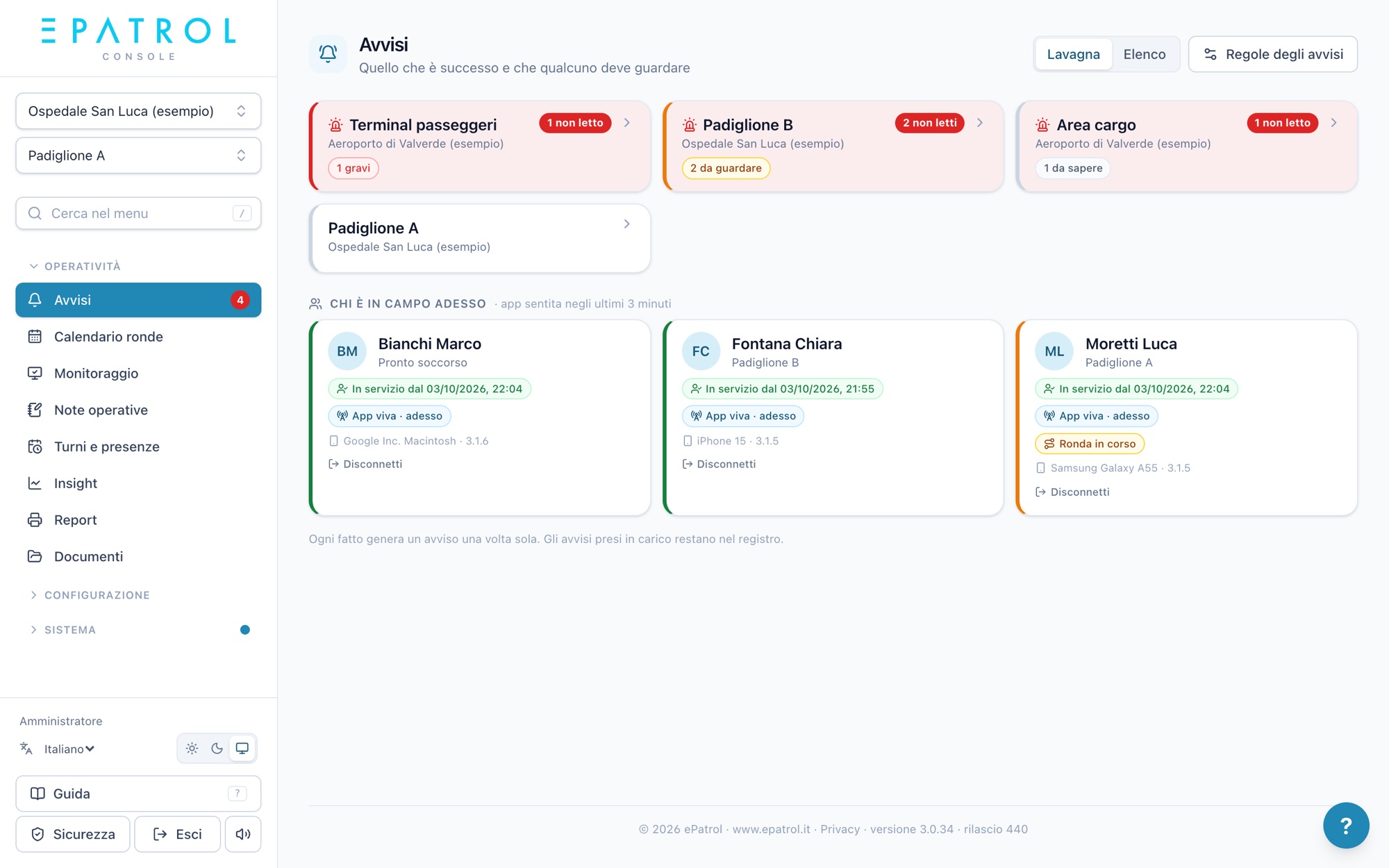
The control room is alerted in real time to situations that need action: patrol not carried out, points skipped, shift not taken up, urgent reports, expiry dates. Alerts arrive in the console, by email and on the phones of the people in charge.
The client has a restricted access with which it checks on its own, at any time, how the service is being delivered on its sites: patrols carried out, staff on duty, open and closed reports, documents and periodic reporting.
Each row is a commitment you can write into your bid, with the tool that makes it possible and the evidence left to the client.
| The commitment | How ePatrol makes it possible | The evidence that remains |
|---|---|---|
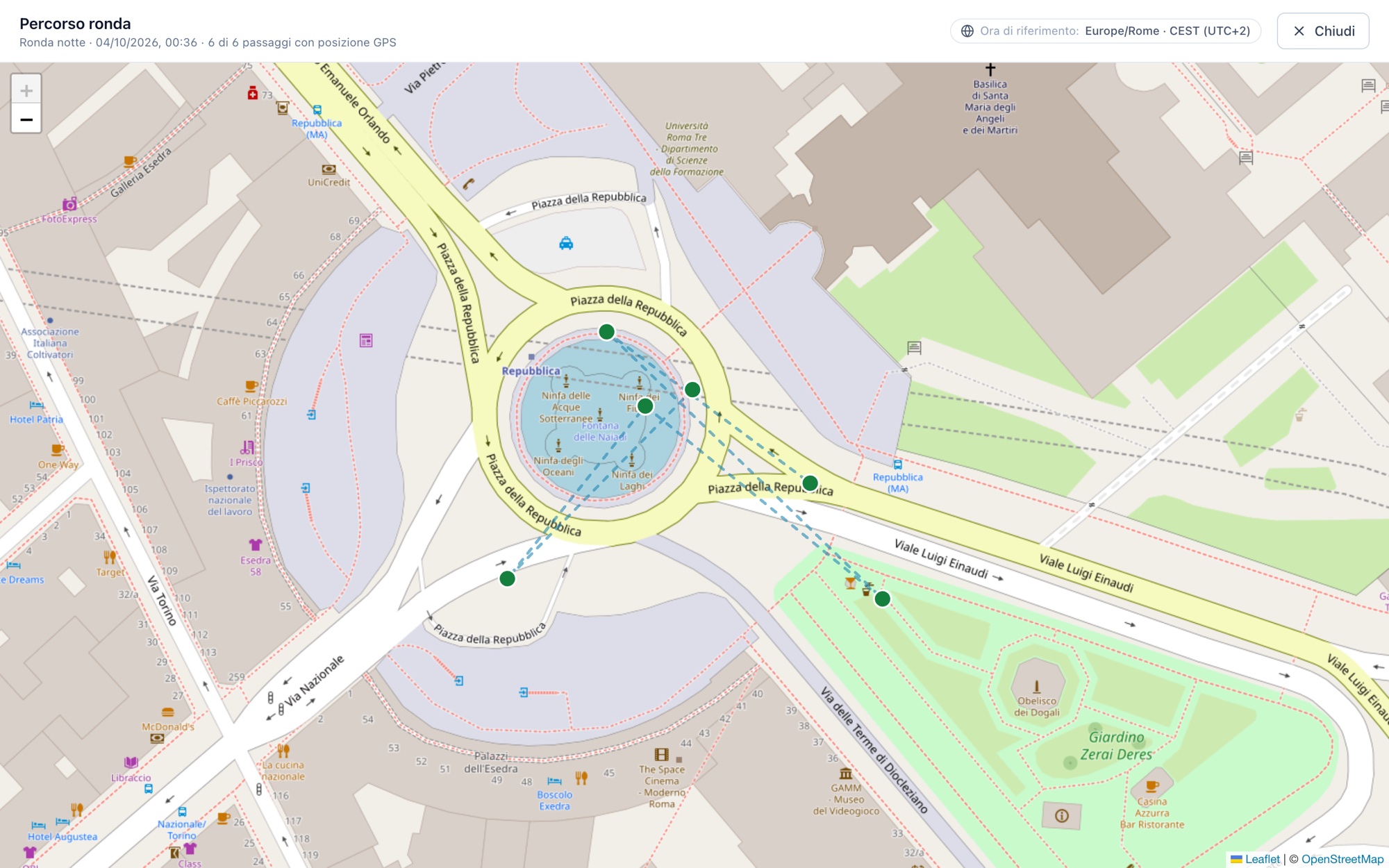
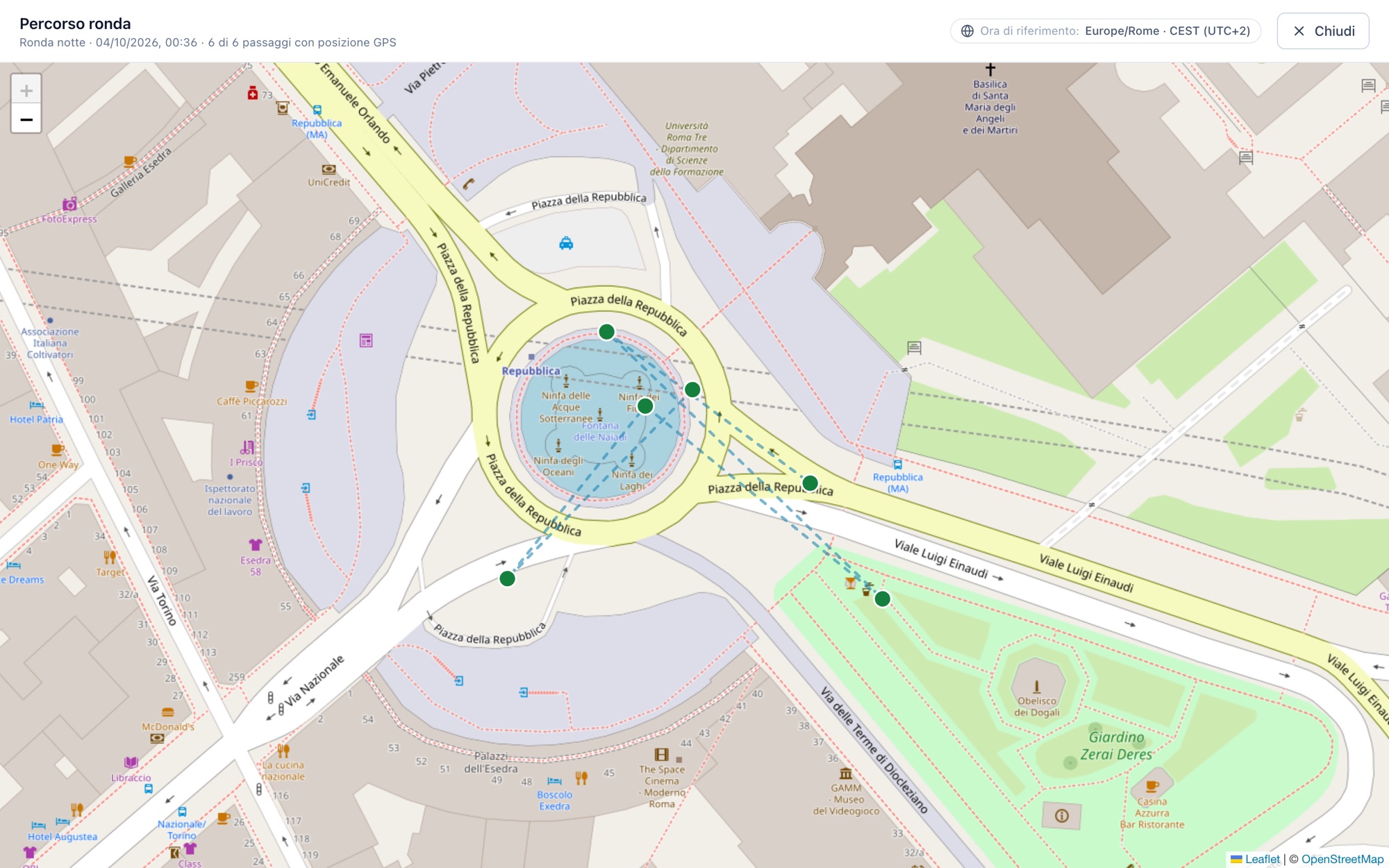
| Every patrol can be proved point by point | NFC tags on every checkpoint, read with the phone | Time, position and operator of each reading; route on the map |
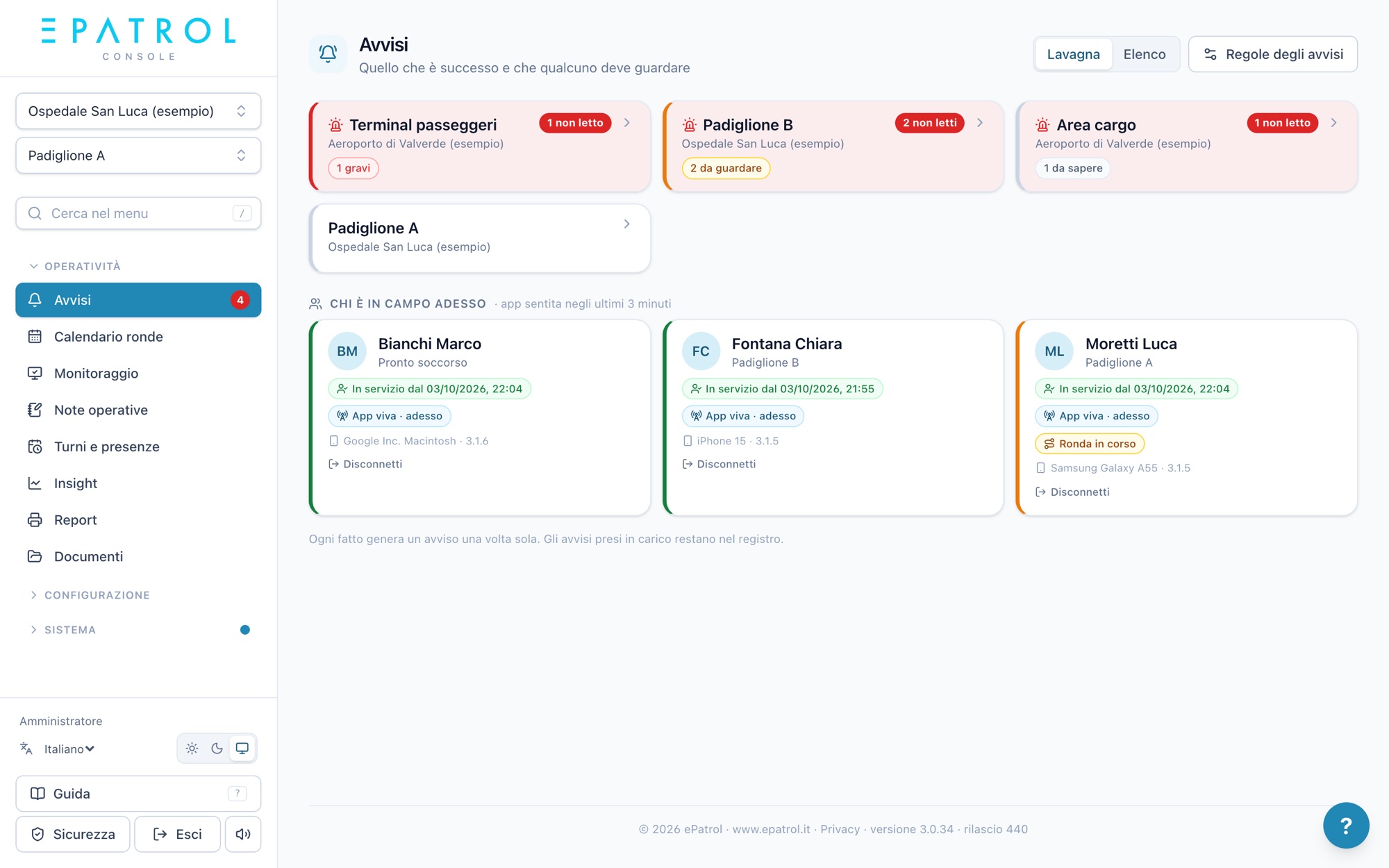
| A missed patrol is detected at once | Automatic alerts for patrols not carried out and skipped points | Alert log with opening and closing time |
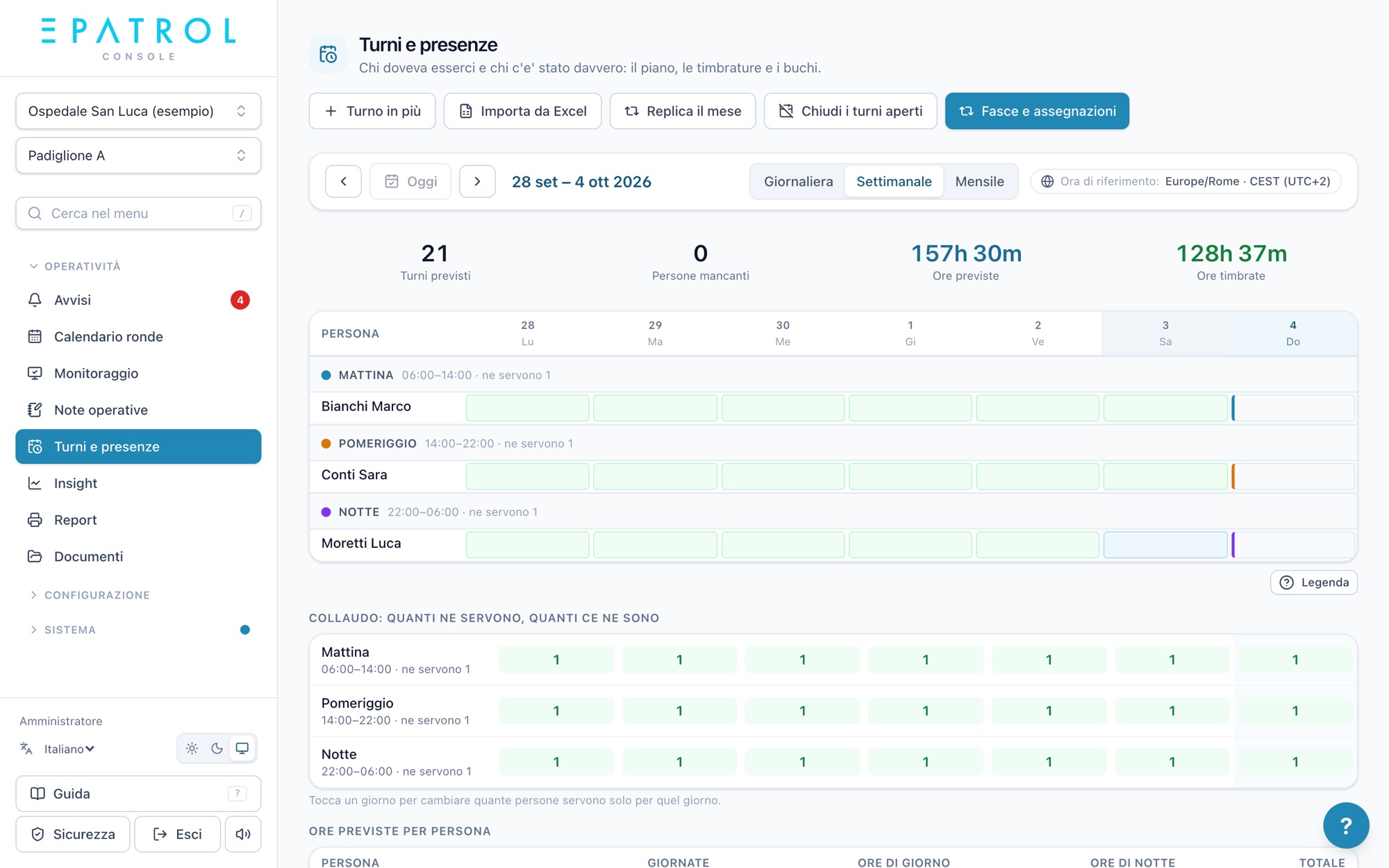
| The site is always covered | Shift plan with clocking in and out from the phone | Planned shifts and hours actually worked, per person |
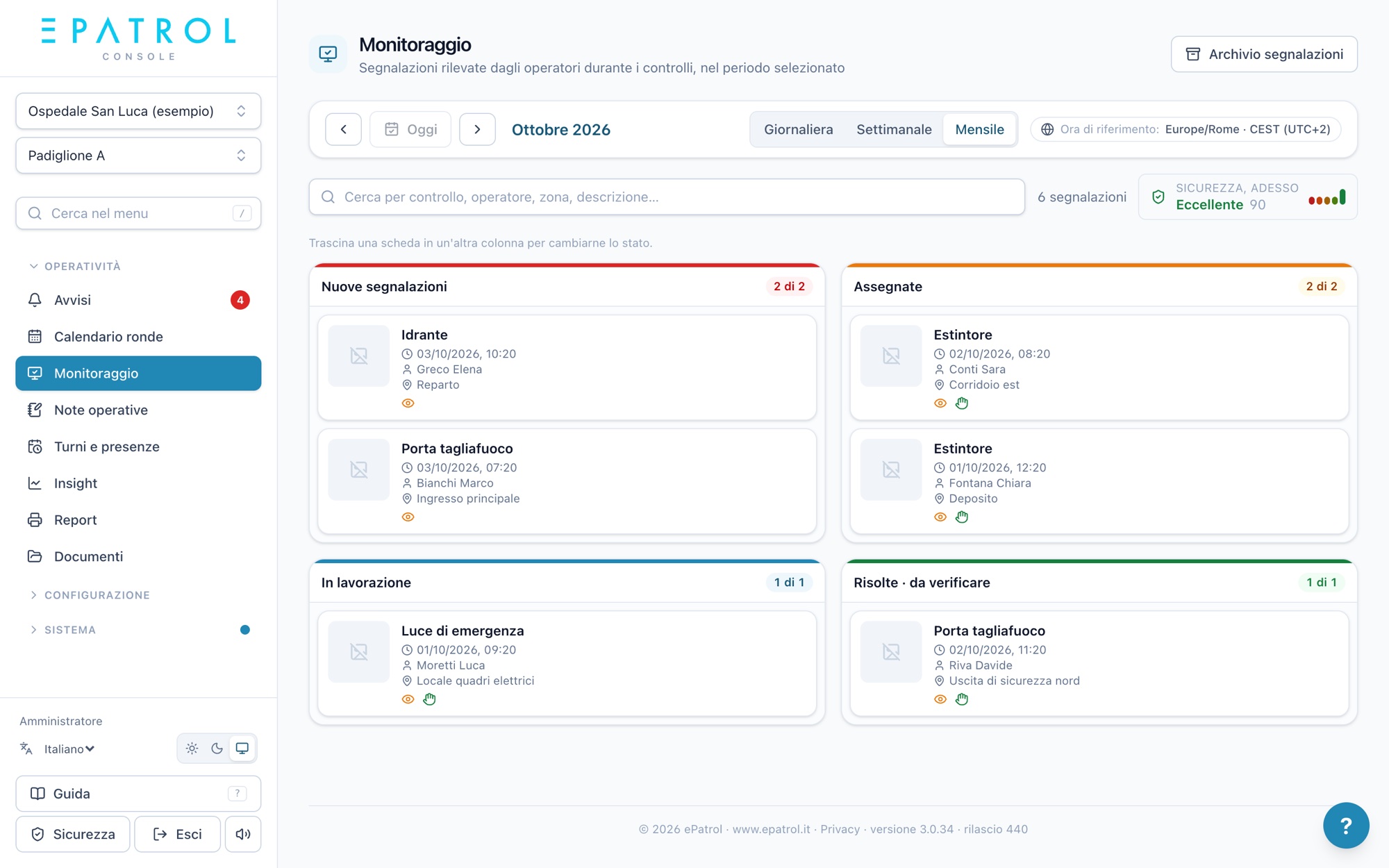
| Every fault is followed through to resolution | Reports with photo, assigned to maintenance and closed after verification | History of each intervention, with closing times |
| The client checks on its own | Restricted access to its own sites only | Data available at any time, without asking for it |
| The service continues with no network | The app records on the phone and sends when the signal returns | No reading lost, with the real time of each visit |
| Staff on site are qualified | Qualifications with expiry dates and renewal alerts | Folder of the qualifications of the site's staff |
| Handovers between shifts are tracked | Service log with notes, photos and urgency level | Handover history, available to the control room |
| Procedures and service orders are read | Documents per site with read acknowledgement | Log of who read each document, and when |
| Reporting is on time | Patrol, attendance and issue reports by period | PDF and CSV reports, also sent automatically |
| Data is protected | Personal access, permissions per contract, two-step verification | Log of operations and of document readings |
Tender criteria resemble each other. Here is a paragraph for the most frequent ones, to adapt to your service.
Delivery of the service is controlled objectively and continuously. Every point to be guarded has an NFC tag: the operator reads it with the phone and the system automatically records the time, the position and the identity of the person. The control room sees in real time the patrols carried out, those in progress and those running late, and who is on duty at each site. Patrols can be tied to a time window: a patrol carried out outside its window or with missing points raises an immediate alert to the control room, which acts without waiting for the end-of-month check. The client has its own access and can verify on its own, at any time, what has been declared.
All activity is reported with documents produced directly by the system, with no manual transcription: patrols carried out with the detail of points read and points missed, attendance with the hours actually worked, issues with status and closing times. Reports are available by day, week, month or any chosen period, in PDF and CSV format, and can be sent automatically by email to the contacts named by the client. Every figure can be traced back to the original record made on site.
An operator who finds a fault reports it from the phone with a description, a photograph and the exact point where it is. The report reaches the control room at once, which assigns it to the competent maintenance worker; the worker receives a dedicated link, documents the intervention and declares it complete. The operator confirms on site that the problem is solved. Each report keeps its own history, from opening to closure, and feeds a summary index of the site's safety status, which takes into account open faults and how long they have been open.
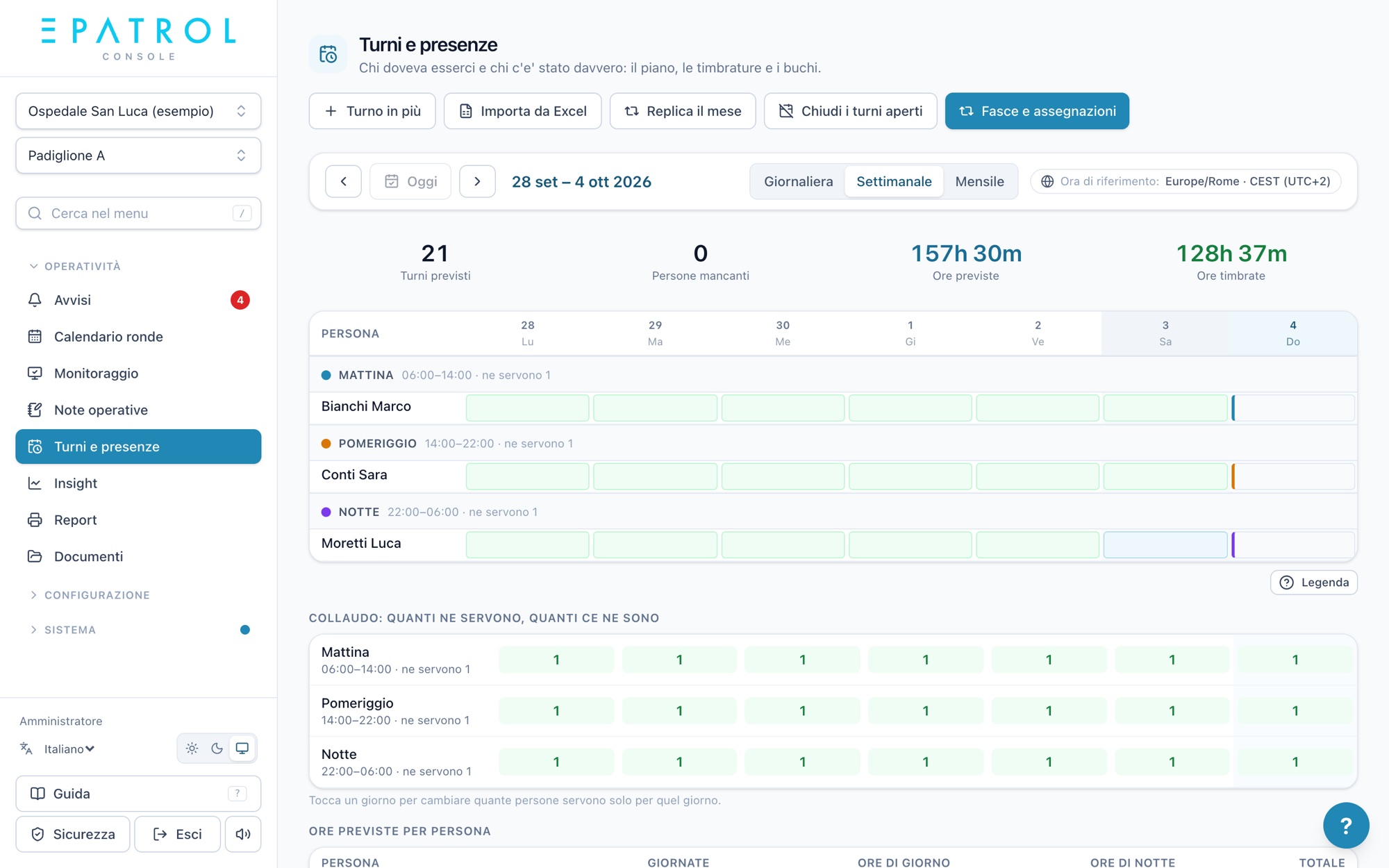
Shifts are planned in the platform and communicated to each operator in the app, with reminders at the start and end of the shift. The operator records the start and end of duty from the phone, on site. The control room is alerted if a shift is not taken up and can arrange a replacement. For each operator the qualifications held are recorded with their expiry dates: the system flags in advance those due for renewal, so that the site is always staffed by people who meet the requirements.
The system is designed for places where network coverage is absent or patchy, such as basements, warehouses and plant rooms. The app keeps recording readings, attendance and reports with no connection and sends them automatically as soon as the signal is available again, keeping the real time of each operation. The handover from one shift to the next takes place through a digital service log, where notes and urgent matters are written down: no information depends on an individual's memory.
Access to the platform is personal and limited to what the role requires: for each contract it is decided what each profile can see and change. One company's data is never visible to another. Access to the console can be protected with two-step verification, and communications between app, console and server are encrypted. Operations carried out are tracked in a log. Personal data is processed on the principle of minimisation: notices are accepted by role with evidence kept, personal documents are visible only to the administrator, and at the end of the relationship data can be permanently deleted.
Compared with traditional systems based on paper registers or dedicated readers, the proposed solution requires no additional devices: the phones issued to staff are enough. The client obtains, at no cost, a restricted access for direct control of the service, receipt of alerts and consultation of reports. Also available are team patrols, in which several operators contribute to the same round and each is recorded as the author of the points checked, and a documented interface to connect service data to the client's management systems.
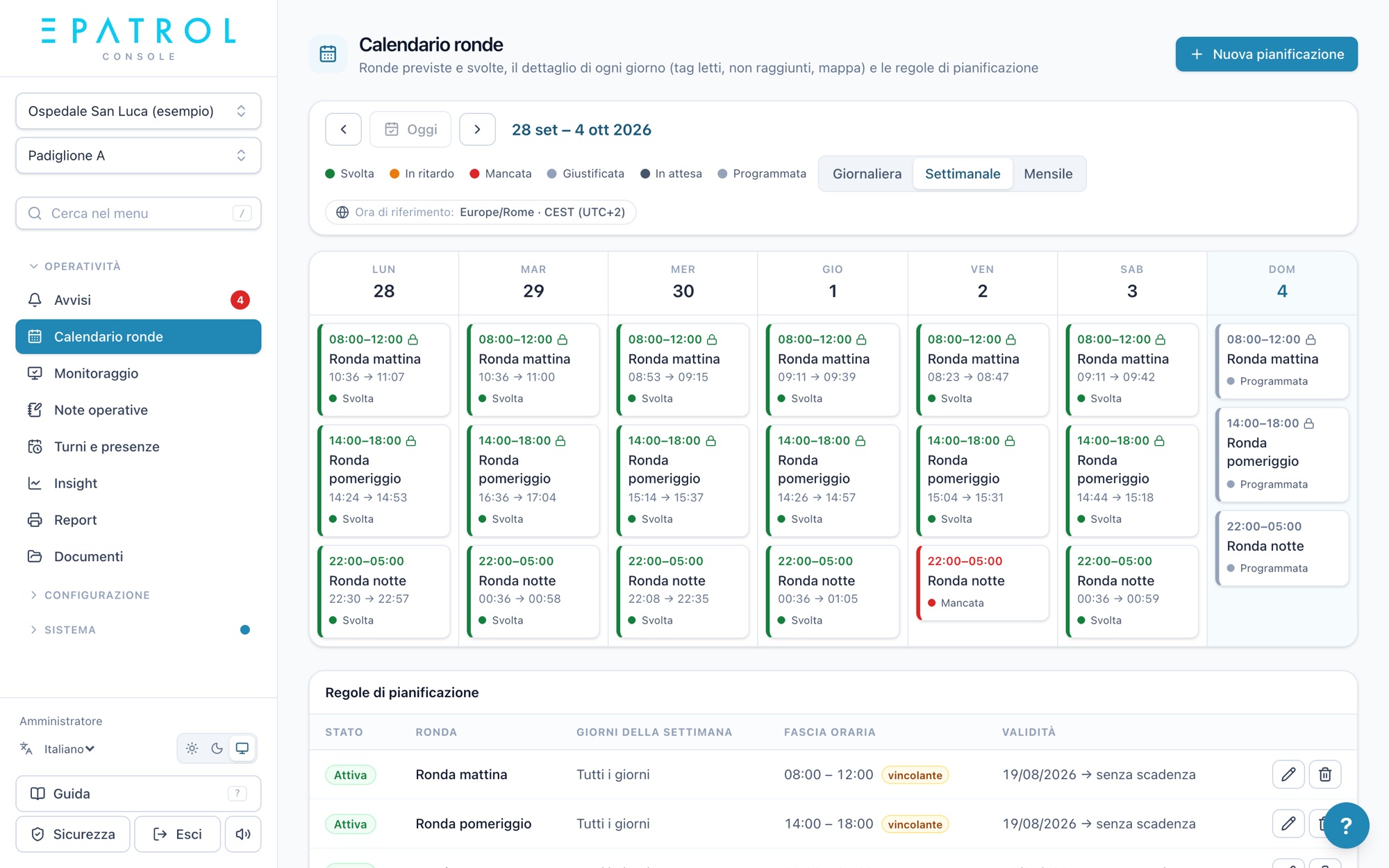
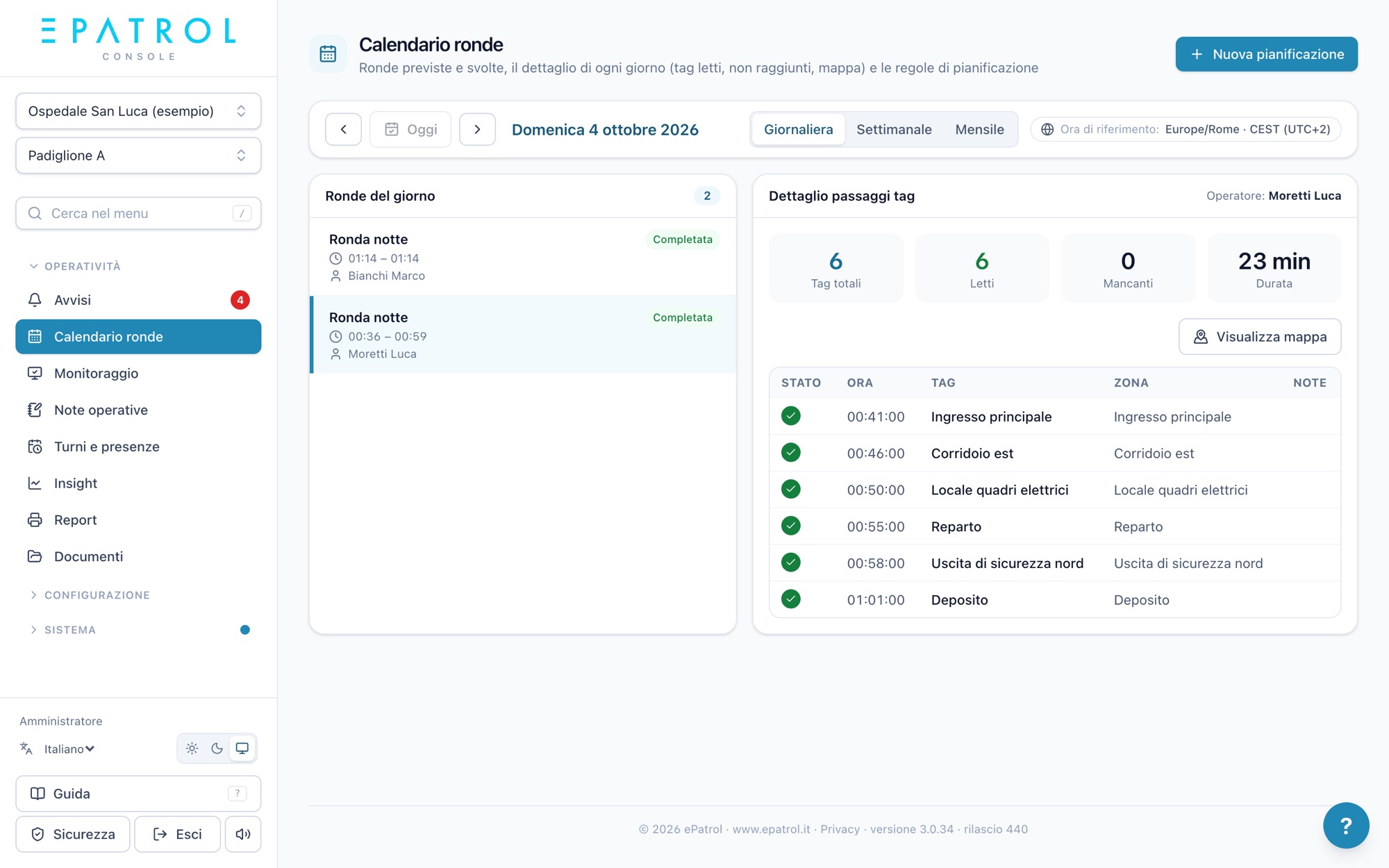
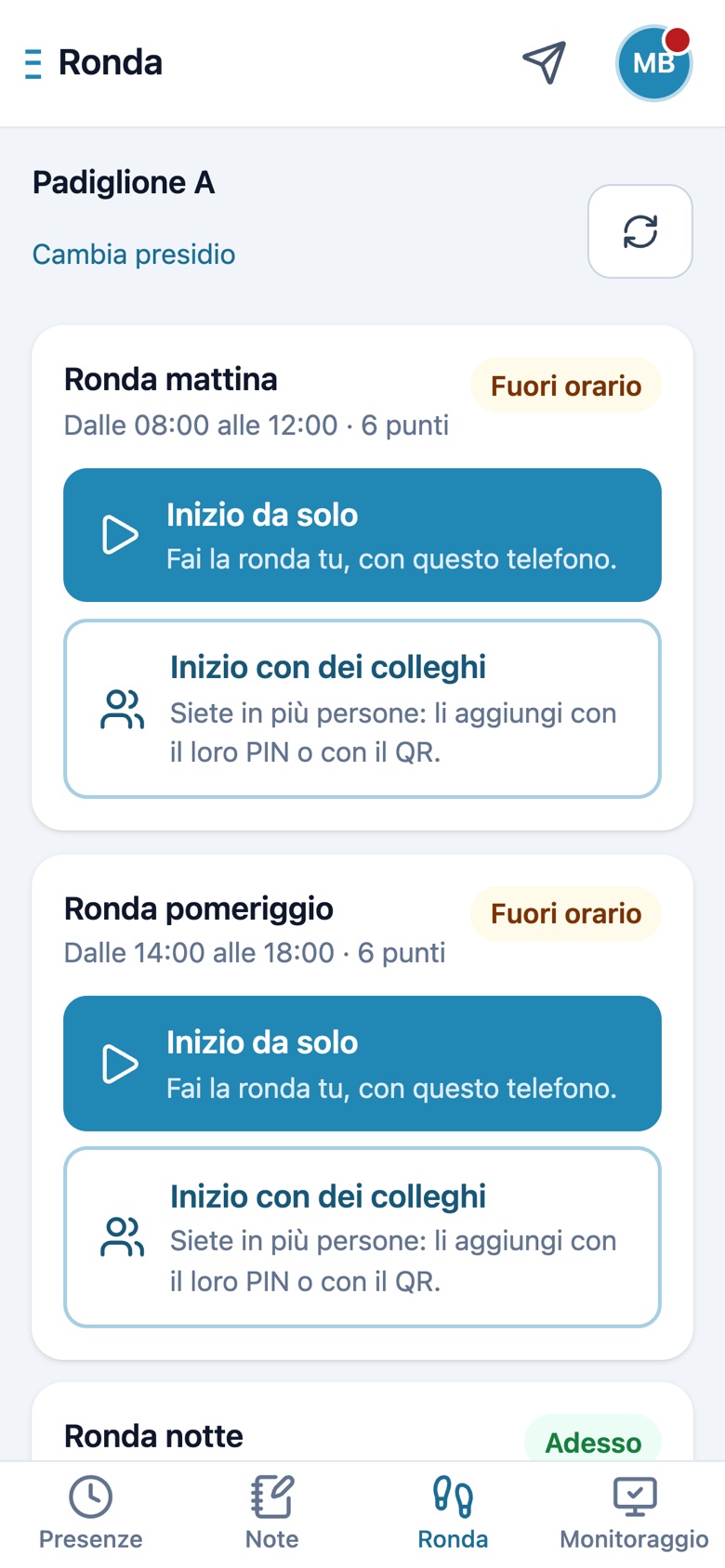
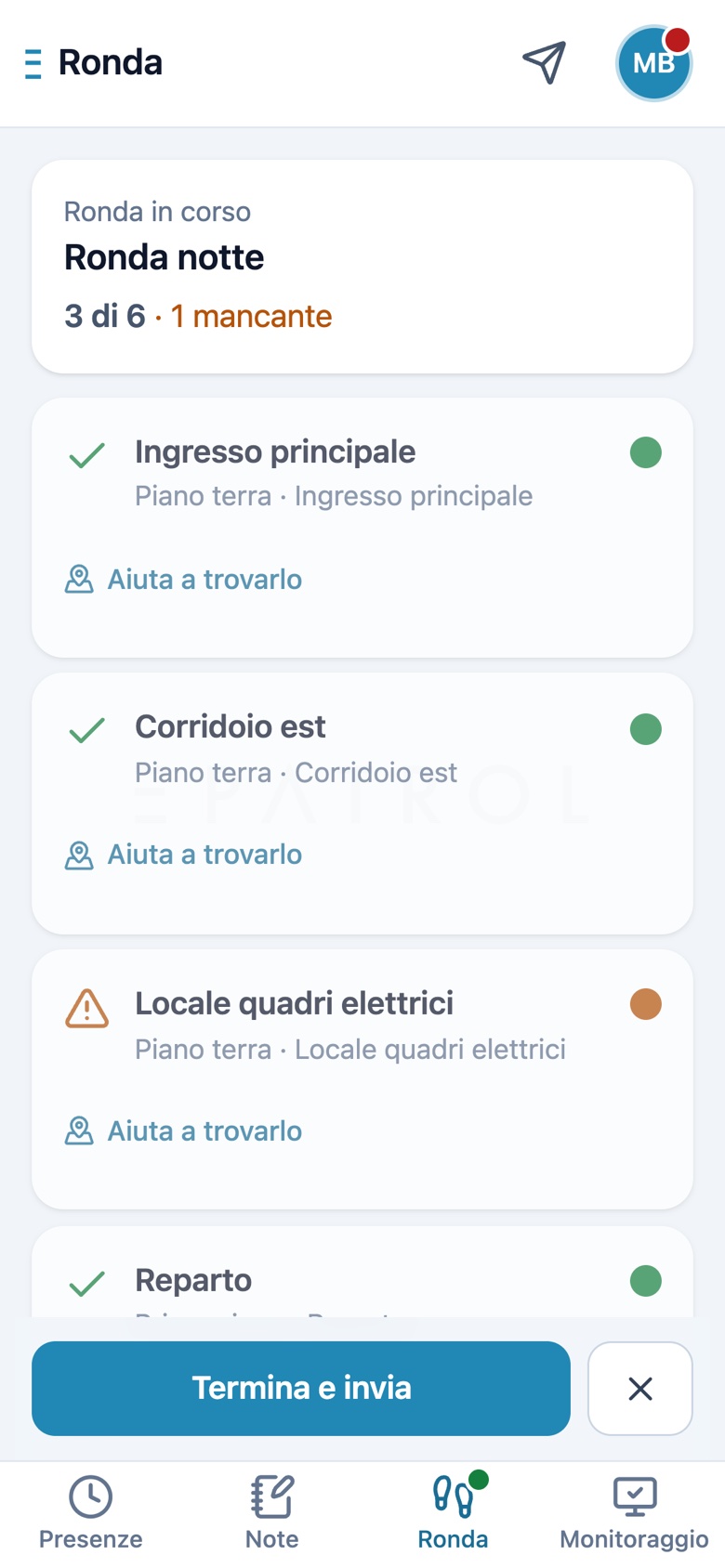
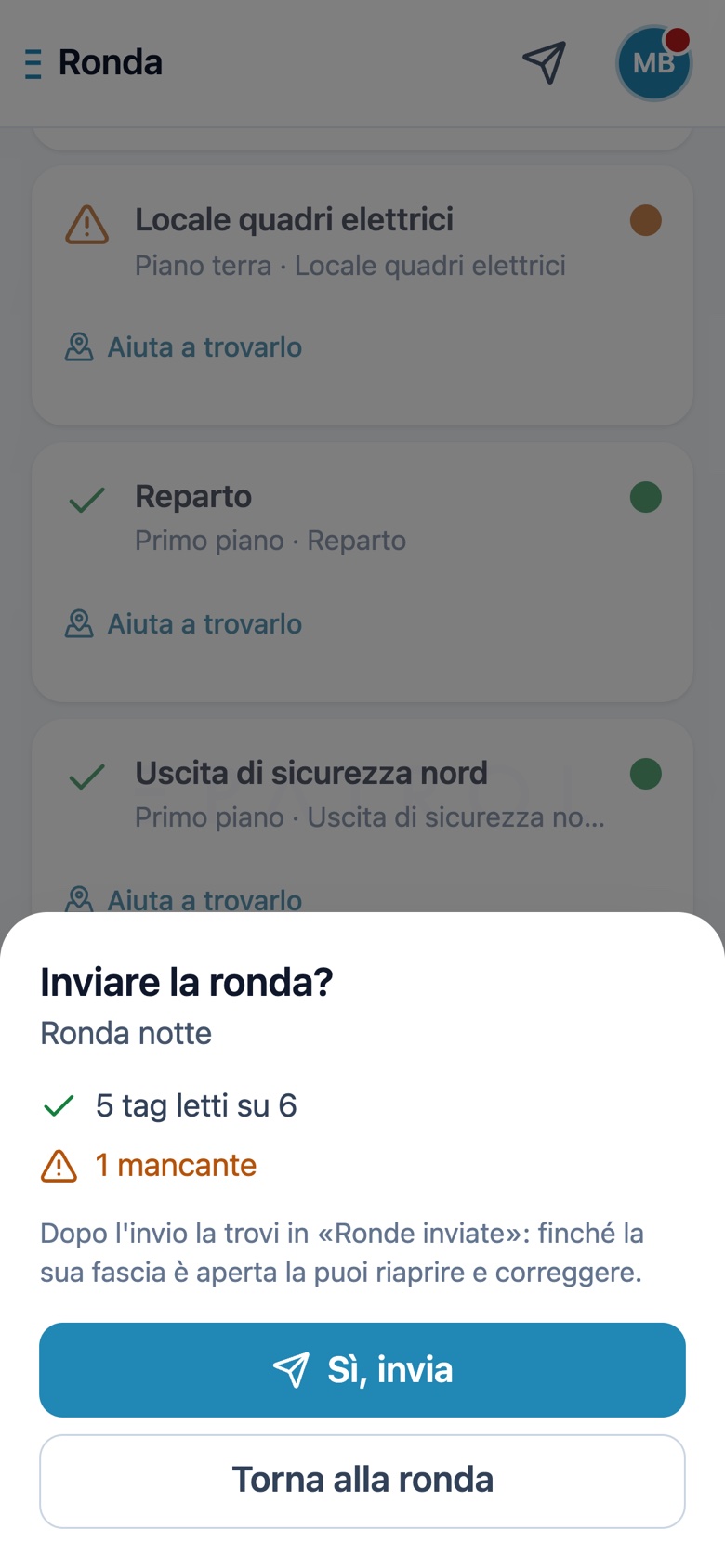
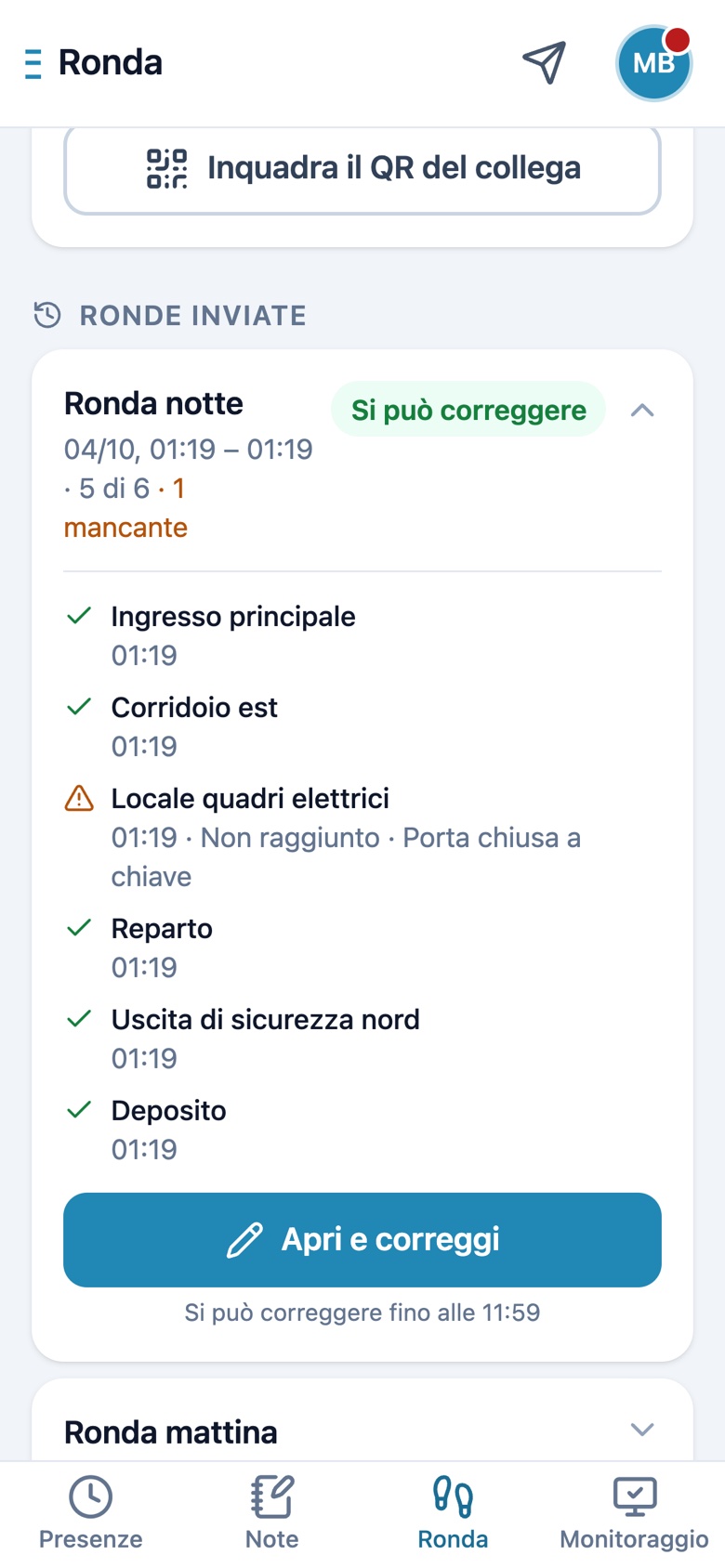
Download the image and copy the caption. They are real screens of the product.
The screens show a demo company: names and places are fictional.
Some data depends on the tender documents and must be declared precisely. Write to us with the tender reference: we prepare it for you.
Write to us about your tenderIf the tender rules allow it, you can ask for the system description to be excluded from access by other bidders. Have the text checked by your bid office.
This section contains information that constitutes technical and trade secrets: the organisation of the functions, the methods of service control, the security measures and the integrations described are the result of own investment and represent a competitive advantage. Its exclusion from access to the records by other bidders is therefore requested, under public procurement law, without prejudice to the right of defence. The ePatrol software is protected by copyright law; the ePatrol name and trademark are the exclusive property of their owner.